Tree Planting in Westchester, FL
A good shade tree can take the edge off a Miami summer and cool a block house for decades. We plant trees in Westchester, FL, from a single live oak in a front yard to a row of palms along a fence, and we pick species that can stand up to hurricane season and grow in our rocky ground.
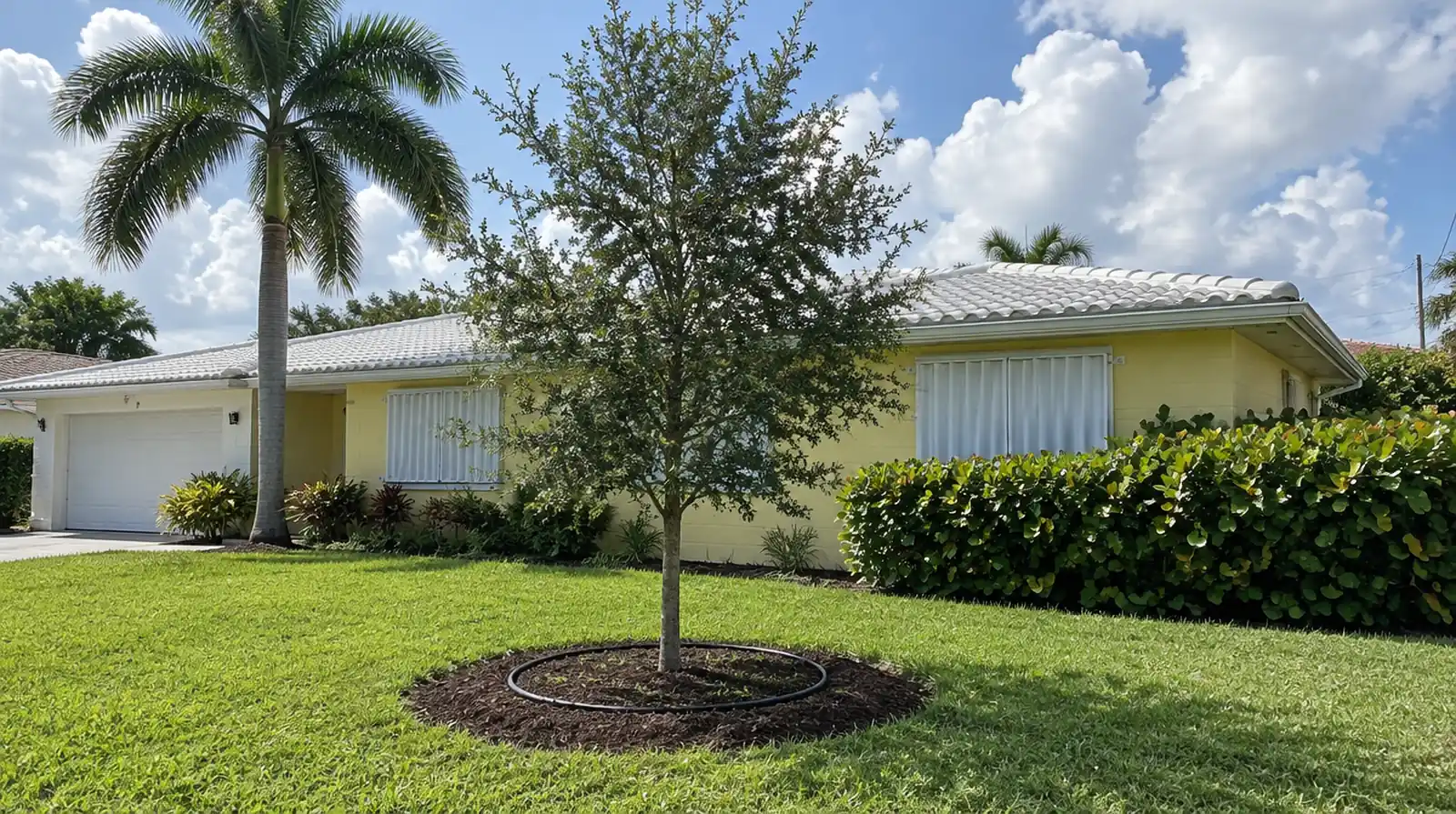
Why planting here is different
Most of Westchester sits on Miami oolite, the white limestone that lies just under a thin layer of sandy soil across much of Miami-Dade. In plenty of yards you hit rock within a few inches. Roots can grow into cracks in the stone, but a tree dropped into a small, round hole chipped out of rock often ends up circling its roots inside what is basically a pot. We cut a wide planting hole, break up the rock at the edges so roots can get out, and backfill with the native soil and broken rock rather than filling the hole with rich potting mix that holds too much water.
The second difference is wind. Every tree we plant here has to make it through hurricane season, June through November, year after year. Some trees hold up far better than others, and that should drive what you plant more than how fast it grows.
Trees that do well in Westchester yards
- Live oak. A strong, wind-firm shade tree when it has room to spread. Best for larger front and corner lots.
- Gumbo limbo. A South Florida native with red, peeling bark. Very tolerant of wind, drought and rocky soil.
- West Indian mahogany. Native to South Florida and a classic Miami street tree with dense shade.
- Pigeon plum and satinleaf. Smaller natives that fit tight side yards and look good year round.
- Green buttonwood and Simpson's stopper. Good choices for screens and small spaces.
- Sabal palm. Florida's state tree. Sabals and other wind-firm palms are a good fit near the house or under lines where a broad canopy will not fit.
There are also trees we steer people away from. Ficus hedges and trees grow huge, and their roots lift sidewalks, crack slabs and find their way into pipes. Black olive drops staining debris on cars and pool decks. Brazilian pepper and Australian pine are invasive in Florida and should not be planted at all. Avocado and other trees in the laurel family can be killed by laurel wilt, a disease spread by the redbay ambrosia beetle, so we are honest about that risk if you want one.
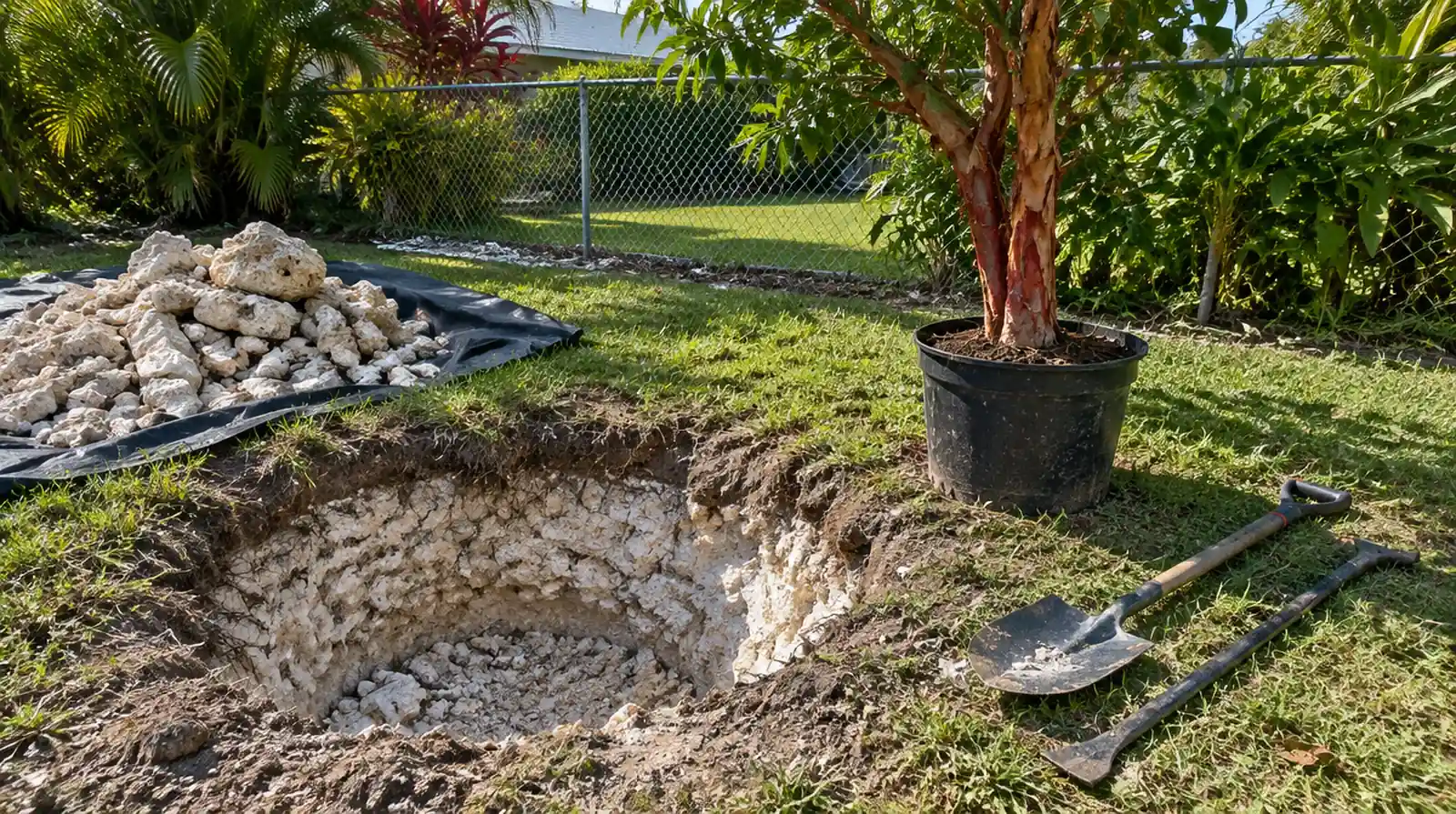
Right tree, right place
Most homes in Westchester were built in the 1950s and 1960s on modest lots, with power lines along the street or the back property line. A tree that will top out at 50 feet does not belong under a wire, and FPL will trim it hard later if it reaches the lines. We plan the spot with the mature size in mind: distance from the roof, the slab, the driveway, the septic or sewer line and the pool screen. Trees planted with room to grow need far less pruning later and stand up better in storms.
Before we dig, we call Sunshine 811 so underground utilities are marked. If you want a tree in the swale between the sidewalk and the street, that is public right of way, and Miami-Dade has rules about what can go there and where. We will tell you what we know and point you to the county before anything gets planted in the swale.
How we plant
- Pick quality stock. We look for a straight central leader, a root ball without circling roots and a trunk flare that sits at the soil line.
- Dig wide, not deep. The hole is two to three times the width of the root ball. The flare stays at or slightly above grade, never buried.
- Stake lightly, briefly. Larger trees get flexible staking for their first year so they can root in. We come back to remove it, since stakes left on too long weaken the trunk and girdle bark.
- Mulch. A ring of mulch two to three inches deep, pulled back from the trunk. No volcano piles.
- Water plan. You get a simple watering schedule for the first months. New trees need regular water until their roots spread, even with our summer rains.
When to plant
You can plant here almost any month, but the start of the rainy season, roughly late May into June, gives a new tree months of steady rain to root in. Winter planting works too, as long as you keep up with watering through the dry season from about December to April. We avoid planting large trees right before a storm is forecast.
Free trees and replacement trees
Miami-Dade runs an Adopt-a-Tree program that gives residents free young trees at events through the year. We are happy to plant those for you along with anything you buy. We also plant replacement trees after a removal, whether the old tree came down in a storm or the county asked for a replacement as part of a removal permit.
Common questions
Can you plant palms too? Yes. Palms are planted differently from shade trees, and we brace them properly until they root.
How big a tree can you plant? Anything from small container trees to larger field-grown trees that need equipment to set.
Do you work in nearby areas? Yes, including Coral Terrace, Olympia Heights, Fontainebleau, Sweetwater and Westwood Lakes.
Plan your new trees
Call (786) 431-0807 and we will look at your yard, talk through species and price the planting.